- Other Fluke companies:
- Fluke
- Fluke Biomedical
- Fluke Networks
- Fluke Process Instruments
See more Fluke brands



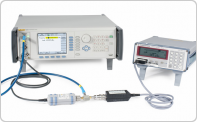
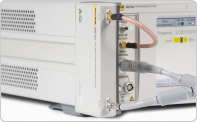
The 96040A 4GHZ and 96270A 27GHz RF reference sources are the core of an RF calibration system, maximizing utility and efficiency. Designed specifically for RF Calibration these products provide superior phase noise performance, an integrated frequency counter, and wide-offset phase noise filter accessory.
Radio frequency and microwave (RF and microwave) calibration take over at the higher frequencies beyond those encountered in dc and low frequency ac (dc lf) calibration. The boundary is somewhat blurred, but most metrologists consider it to be in the 1 – 10 MHz region. RF and microwave calibration activities are often undertaken in separate labs within a calibration facility, with microwave calibration taking place in yet another area. Again there is no specific boundary, but microwave frequencies are generally considered to be those above a few GHz. At even higher frequencies, around 100 GHz, the term millimeter wave is often used. Regardless of a calibration facility’s approach to frequency segregation, there are many common elements.
The most significant is that RF and microwave equipment and systems employ matched transmission lines for interconnection (coaxial cables or waveguides at higher frequencies).
Two key parameters are RF power and a measure of how well it is matched or delivered from a source to a load. The quality of match to the transmission line characteristic impedance is typically expressed in terms such as voltage standing wave ratio (VSWR), reflection coefficient and S-parameters, etc.
Mismatch errors are major contributions to measurement uncertainty in RF calibration. These arise from the output and input matches of the equipment and from the cables and connectors used to interconnect the equipment. Using high quality metrology grade connectors and cables, and treating them with care are essential in minimizing these sources of error and uncertainty.
Many other parameters and characteristics are measured when calibrating RF and microwave test equipment, too numerous (and often instrument-specific) to discuss here.
Unlike dc /lf calibration where there are many dedicated calibrators, in RF and microwave there are virtually no specifically designed calibrators (apart from the Fluke Calibration 96000 Series RF Reference Sources). To calibrate an RF and microwave workload item, it is necessary to collect a variety of different pieces of test equipment to provide the required functionality and performance.
The equipment may be assembled as a system dedicated to a particular type of instrument, as a system capable of calibrating many workload instrument types, or simply collected from the lab inventory for a specific calibration task and dispersed when the task is completed.
Because so many system instruments are involved, there are many different setups required to make connections to the unit or device under test (UUT/DUT). Switching and multiplexing is not possible due to the measurement errors and uncertainty contributions that would be introduced by the switching, particularly at the higher frequencies.
The calibration process may be performed manually, or it may be automated using software to take control of the system instruments and the item being calibrated. Fully automated RF and microwave calibrations are rare due to the difficulty in automating signal switching without degrading measurement quality.
Traditional automated systems need frequent user intervention to change the interconnections. Consequently there are many opportunities for mistakes and highly trained staff is needed. Costly operator time is often wasted waiting for the next setup change.
Instruments usually found in a traditional system include: signal generators, level generator, function generator, power meters, measuring receiver, spectrum analyzer, RF and microwave counters, network analyzer, audio analyzer, oscilloscope, digital multimeter. None of these instruments are designed specifically for calibration; they are all general purpose test instruments that get used in the system. The signal generators are not capable of the performance needed in RF calibration. So they must be used with power meters and calibrated step attenuators to provide sufficient level and attenuation accuracy. External filters are required when low harmonic is important, such as in spectrum analyzer calibration. Signal sources with low phase noise performance are also required for high-performance spectrum analyzer calibration.
Often the same instruments used within the systems appear as calibration workload. Signal generators, spectrum analyzers, power meters, power sensors are the most common workload items. Others include RF millivoltmeters, signal level meters, modulation analyzers receivers and counter/timers.
Employing a Fluke Calibration 96000 Series RF Reference Source, specifically designed for RF calibration, as the core of an RF and microwave calibration system enables many system instruments and accessories to be replaced by just one. The unique combination of features and performance makes the 96000 Series clearly superior to general purpose signal generators. Used manually or partnered with MET/CAL Calibration Software, a 96000 Series Reference Source can halve system costs, improve system capacity by up to 25% and free up 50% of the system operator's time to perform other value-adding tasks.
The 27 GHz 96270A Reference Source covers more than 80% of the test points required for calibrating almost all spectrum analyzers of any frequency range. For many spectrum analyzers operating below 27 GHz, you can perform the entire calibration with a 96270A, or with a 96040A Reference Source for lower frequency models operating below 4 GHz.
The integrated dual power meter readout capabiities of the 96270A also allow you to make RF level measurements to calibrate signal generators, spectrum analyzer tracking generator outputs, and other signal source workload where a separate power meter would usually be required.
The 96000 Series integrated frequency counter lets you reduce the number of instruments required for RF calibration even further.
A guide to calibrating your spectrum analyzer »
RF calibration best practice guide: coaxial connectors »
Understanding phase noise in RF and microwave calibration applications »
Measuring and Certifying Phase Noise Performance of a Low-Noise RF »
There are virtually no instruments specifically designed as RF and microwave calibrators (apart from the Fluke Calibration 96000 Series). RF and microwave calibration procedures are complex, involving many general purpose test instruments, accessories, components, cables, adapters and connectors. Calibration solutions are generally created by users developing and assembling their own systems. Automation is often provided by users writing their own software or employing commercially available test system automation software. Larger organizations may commission systems integrators to put together a calibration system. Some test equipment manufacturers offer software packages for calibrating their own RF and microwave products, which only allows use of their own products as calibration standards and cannot calibrate any other workload.
Employing a Fluke Calibration 96000 Series Reference Source, specifically designed for RF calibration, as the core of an RF and microwave calibration system enables many system instruments and accessories to be replaced by just one. The unique combination of features and performance makes the 96000 Series clearly superior to general purpose signal generators. used manually or partnered with MET/CAL Calibration Software, a 96000 Series Reference source can halve system costs, imprpove system capacity by up to 25% and free up 50% of the system operator's time to perform other value-adding tasks
The 27 GHz 96270A Reference Source covers more than 80% of the test points required for calibrating almost all spectrum analyzers of any frequency range. For many spectrum analyzers operating below 27 GHz, you can perform the entire calibratoin with a 96270A.
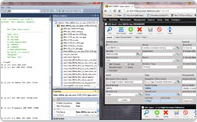
In a typical automated RF calibration process, the operator must intervene frequently to change test setups, thus limiting the benefits that can be realized by the automation. Walk-away automation can increase calibration system capacity by 25 percent or more using procedures developed in MET/CAL Calibration Software. Fluke Calibratoin includes a sample calibration procedure with the 96270A and 96040A, which you can use as the basis for creating additional RF calibration procedures to handle your unique workload.
MET/CAL procedures created by Fluke Calibration for the 9620A models can also be used by the 96270A and the 96040A in 9640A emulation mode.
The 96270A and 96040A are also integrated easily into existing automated systems and software. The time savings and efficiency gains offered by these models can be realized by structuring test sequences to take full advantage of its "connect once measure many" capabilities.
Workload coverage refers to instrument type and its manufacturer; degree of automation means the extent to which a solution addresses its calibration and provides automation.
Spectrum analyzers are key workload items for any RF and microwave calibration lab. The 96000 Series Reference Sources provide the required functionality and performance, and with their superior low phase noise performance, the 96270A and 96040A are capable of calibrating the high-end spectrum analyzers.
The 96000 Series features and performance also make them ideal for other workload, including RF millivoltmeters, signal level meters, modulation analyzers, receivers and counter/timers..
The 9640A Series features and performance also make it ideal for other workload, including RF millivoltmeters, signal level meters, modulation analyzers, receivers and counter/timers.Some RF calibration software packages are only capable of calibrating single-vendor UUTs and also require single vendor system instruments. MET/CAL calibration software does not have this limitation.
RF and microwave calibration is complex, and finding skilled staff can be challenging. The staff possessing the required knowledge and skill have many tasks to perform, and freeing their time to tackle the tasks where utilizing those skill adds the most value is an important consideration in choosing a calibration solution.
Use MET/CAL software’s Flexible Standards feature to automate the other instruments in your system. This capability allows you to substitute equivalent standards within the procedures, so you aren’t locked into a specific reference model. Flexible Standards support is available for popular microwave synthesizers including the HP8340, HP83630, Agilent E8254 and E8257, and other models from Anritsu and Rohde & Schwarz.
The 96000 Series Reference Sources are designed to match or exceed the performance and functionality of the HP3335A and HP8662/3A in the calibration system. Replacing these popular but obsolete and difficult to maintain products becomes just a plug-and-play substitution. HP8662/3A GPIB command emulation is installed as standard on the 96270A and 96040A. The 96270A also includes as standard GPIB command emulation for th eHP8340A, HP38630B Series and the Agilent E8257 Series models.
Systems with many instruments are complex and expensive to support and maintain. The reduction in system instrument count achieved with a 96000 Series Reference Source brings many benefits. Metrology is significantly simpler, with fewer error sources and fewer uncertainty contributions. System support costs are reduced, as there are fewer instruments to calibrate and maintain.
A smaller, compact system is ideal for on-site use, reducing transport costs and also enabling a system to be easily taken to locations inappropriate for a larger system.
Many applications in R&D, manufacturing test, ATE, and scientific research require better performance than a general purpose signal generator. The 96000 Series' unique combination of level and attenuation accuracy, signal purity and low jitter, frequency resolution, dynamic range and precision modulation deliver better performance than any high performance signal generator in these applications.